
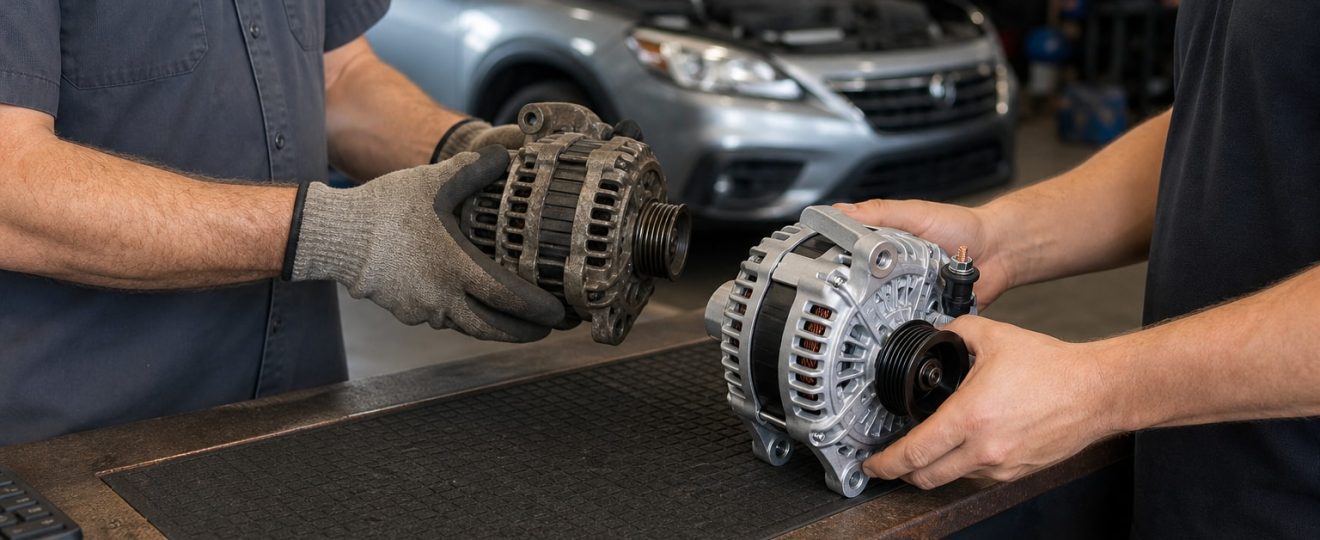
A clean alternator on a parts counter can hide three very different histories. It may be new, rebuilt from a used unit, or simply removed from another vehicle and cleaned for resale. The housings can look similar, yet the price, return conditions, testing record, and warranty exposure may be completely different. The useful question is not which label sounds best. It is what the seller can prove about the part behind that label.
The FTC’s used-parts guide treats those descriptions as meaningful claims. A seller should not present a used part as new, misstate its condition or previous use, or use terms such as rebuilt and remanufactured without the processing those terms require. That makes the wording on the listing, invoice, and part itself part of the buying evidence, not decorative marketing.
Condition is only one half of the decision. A correctly described alternator can still be wrong for the vehicle, and a valid warranty cannot correct a mismatched connector or pulley. If the application is uncertain, verify the vehicle and replacement-part identity first, then compare condition, core rules, and warranty terms.
THREE LABELS, THREE DIFFERENT HISTORIES
Remanufactured or rebuilt
A remanufactured or rebuilt component begins with a previously used assembly. It should be taken apart far enough to inspect the working surfaces, replace or restore deficient components, reassemble the unit, and test its operation. The exact process can still vary by rebuilder and by part type. An alternator may have bearings, brushes, a regulator, rectifier, and pulley inspected separately; a steering rack has a different set of wear points and test requirements.
Ask what was replaced routinely, what was replaced only after inspection, and what final test was performed. A meaningful answer names a load test, pressure test, leak test, electrical output range, or another part-specific procedure. “Professionally rebuilt” without a test description, serial trace, or warranty issuer is a promise that is difficult to evaluate later.
Salvage or used
A salvage part normally comes from another vehicle without a full rebuilding process. That can be reasonable for a body panel, bracket, mirror housing, or discontinued trim piece when condition is visible and the donor application is documented. It carries more uncertainty for a component whose wear happens internally. Mileage, storage exposure, collision location, corrosion, fluid contamination, and the donor vehicle’s failure history can matter more than a polished exterior.
For an electronic module, request the donor part number and any programming requirements. For a mechanical assembly, ask whether it was function-tested before removal and whether the seller records donor mileage. A short exchange warranty may be useful, but it is not the same as evidence that the part was rebuilt.
New does not automatically mean original-equipment
A new part may come from the vehicle manufacturer or an independent aftermarket producer. The important distinction is not simply the logo. Check the actual manufacturer, specification, connector layout, included hardware, and warranty provider. Keep the product page or written quotation that identified the part as new; if the delivered unit is marked rebuilt, remanufactured, recycled, or used, stop before installation and resolve the discrepancy.
THE CORE CHARGE IS A RETURN DEPOSIT
A core is the old component that still has rebuilding or material value. The core charge encourages its return. The California Bureau of Automotive Repair’s explanation describes it as a deposit set by the manufacturer or supplier and notes that it can appear on new as well as remanufactured parts. It also gives a useful paperwork model: show the charge separately rather than burying it in the price. Tax, disclosure, and return rules vary by location, so confirm the seller’s terms before ordering.
The lowest advertised price can therefore be incomplete. A $140 replacement with a $100 refundable core deposit ties up $240 until the old part is accepted. Shipping a heavy starter, steering gear, or brake caliper back to an online seller can reduce or erase the saving if return freight is not included. A local counter may cost more initially but let the buyer inspect the replacement and return the core in one visit.
Do not dismantle, paint, weld, or discard the old unit before reading the core policy. Some sellers accept a damaged core; others reject missing housings, cracked mounting ears, stripped threads, fire damage, or units that are not the same application. Drain fluids only as directed, cap openings, retain brackets unless the instructions say they transfer to the new part, and photograph the core before it leaves your possession.
A PARTS-COUNTER CASE: THE $140 ALTERNATOR
Imagine two alternators listed for the same vehicle. The first is $140 plus a $100 core charge, includes a prepaid core label, and has a two-year parts warranty. The second is $165 with no core return and a 90-day exchange warranty. The cheaper line is not automatically the better value, and neither is the more expensive one.
The useful comparison starts with five facts: who rebuilt or supplied each unit, which output specification applies, whether the pulley and connector match, what proof is required for a warranty claim, and whether labor or towing is excluded. Add the cost and deadline for the core return. If the first seller requires the old alternator within 14 days but the vehicle cannot be disassembled until the following month, the refundable deposit may become a permanent cost.
Before leaving the counter, rotate the pulley by hand when appropriate, compare mounting ears and electrical terminals, inspect castings for impact damage, and confirm that protective caps are present. These observations do not replace bench testing. They catch shipping damage and obvious mismatch before the old core is surrendered.
WARRANTY QUESTIONS THAT CHANGE THE REAL PRICE
The FTC’s auto-repair guidance distinguishes new, remanufactured or rebuilt, and salvage parts, and reminds buyers that there is no single standard warranty for repairs. A parts warranty may cover another component while excluding diagnosis, removal, installation, fluids, programming, freight, or damage caused by another system. Those exclusions can cost more than the replacement itself.
Ask who decides that the part failed and where testing must occur. Find out whether a claim requires the installer’s invoice, vehicle mileage, diagnostic codes, maintenance records, or return of the failed unit. If the vehicle is used commercially, carries a plow, has modified electrical loads, or operates outside the seller’s market, check for exclusions in writing.
A lifetime warranty also needs a definition. It may mean the original purchaser’s ownership period, not the life of the vehicle, and it may provide repeated replacement parts without paying repeated labor. Compare the remedy and claim process rather than the headline duration.
WHEN REBUILT CAN BE THE MORE TRACEABLE CHOICE
Rebuilt does not mean second-rate by definition. For fleet purchasing, EPA’s vehicular-products guidance describes rebuilt parts as remanufactured and tested, with processing tied to the FTC guide. That public-procurement context does not certify every retail listing, but it shows why process documentation and performance testing are better decision tools than appearance alone.
A reputable rebuilder may offer a consistent bill of materials, test record, technical support, and a return stream that keeps usable housings in service. That can be more traceable than an untested salvage component and more practical than a new original-equipment part that is discontinued or backordered. The choice is strongest when the rebuilder is identified, the application is exact, and the warranty remedy is usable where the vehicle is serviced.
THE PAPER TRAIL THAT CLOSES THE LOOP
Before paying, put the transaction into a form that another person can understand. A useful invoice or saved order record identifies:
- the seller, manufacturer or rebuilder, and exact part number;
- the stated condition: new, remanufactured, rebuilt, reconditioned, salvage, or used;
- the vehicle application and any output, calibration, or programming specification;
- the core charge, return deadline, accepted condition, shipping responsibility, and tracking number;
- the warranty period, covered remedy, labor exclusions, and claim contact;
- the delivered unit’s serial or batch identifier and installation mileage.
Photograph the old core, the replacement, and the labels before installation. Keep the shipment receipt until the core credit appears, then save the credit notice with the purchase and installation records. That small file turns a vague parts-counter promise into a sequence that can be verified: what was ordered, what arrived, what was returned, and what the seller agreed to cover.

