
Replacement parts are often sold under a broad year-make-model label, but that label is only the start of a fitment check. A mid-year production change, a different engine, a two-wheel-drive versus four-wheel-drive chassis, an optional brake package, or one electrical connector can turn an apparently correct part into an expensive return. The safest ordering process treats the catalog listing as a lead and the vehicle itself as the final reference.
Begin with the complete 17-character VIN rather than a remembered trim name. The official NHTSA VIN Decoder can identify information encoded in the VIN and reports manufacturer-supplied data such as the vehicle and plant details. It does not certify that a retail part fits, so use the decoded identity to narrow the search and then confirm the service part number with the vehicle maker’s catalog, parts counter, or repair information.
BUILD A VEHICLE IDENTITY SHEET FIRST
Write the vehicle data down before opening several catalog tabs. This prevents details from drifting while you compare listings. Record the VIN, model year, make and model, build month, engine size or code, transmission, driven wheels, body style, and trim. For pickups, add cab style, bed length, payload or gross-weight package, rear axle information, and whether the truck has factory tow, off-road, or heavy-duty brake equipment.
Use the certification label, option-code label, owner’s information, and the old component as evidence. A seller’s drop-down menu may not ask about every production split. If the catalog says “from 03/2021,” “with 330 mm rotor,” “without adaptive suspension,” or “except heavy-duty cooling,” treat that note as a hard condition rather than a suggestion.
Keep the identity details in one fitment file
- Photograph the VIN plate and the certification label without posting the full VIN publicly.
- Capture the build date, engine code, axle or brake option, and any relevant emissions label.
- Save a wide photo of the installed component and close-ups of labels, connectors, brackets, and hose routing.
- Note whether the vehicle has factory equipment, a dealer accessory, or an earlier aftermarket conversion.
TRANSLATE NUMBERS BEFORE TRUSTING A LISTING
The most useful number is usually the current orderable service number. A casting number, patent number, supplier number, or number molded into a housing may describe only one piece of an assembly. It can look convincing while pointing to the wrong product. Search the exact number, but verify what kind of number it is before treating it as a match.
Service numbers also change. A manufacturer may supersede an old number with a revised part that fits several earlier applications. That can be legitimate, but the supersession path should be traceable in an OEM catalog or confirmed by a parts specialist using the VIN. Do not assume that two numbers are interchangeable because an unverified marketplace listing places them in the same title.
| Evidence | What it can confirm | What can still go wrong |
|---|---|---|
| VIN and build data | Vehicle configuration and production range | The part listing may omit an option split |
| OEM service number | Cataloged replacement or supersession | A copied seller cross-reference may be inaccurate |
| Old-part markings | Supplier family or component revision | A casting number may not be an orderable assembly |
| Measurements and connectors | Physical interface and packaging | Internal calibration or material may still differ |
CHECK SAFETY STATUS BEFORE BUYING
Before paying for a safety-related component, search the vehicle by VIN on the official NHTSA recall lookup. Its VIN search can show an unrepaired recall for participating manufacturers, while a year-make-model search provides broader recall and investigation results. A covered defect may have a manufacturer remedy, and the correct remedy part or procedure may differ from a generic retail replacement.
This check matters for more than airbags. Steering, brakes, fuel-system hardware, tires, electrical equipment, trailer connections, and other components can be involved in safety campaigns. If a recall appears relevant, follow the manufacturer’s instructions or contact a dealer before removing the original part. A retail purchase should not replace a recall diagnosis.
MEASURE THE INTERFACES THAT ACTUALLY MATTER
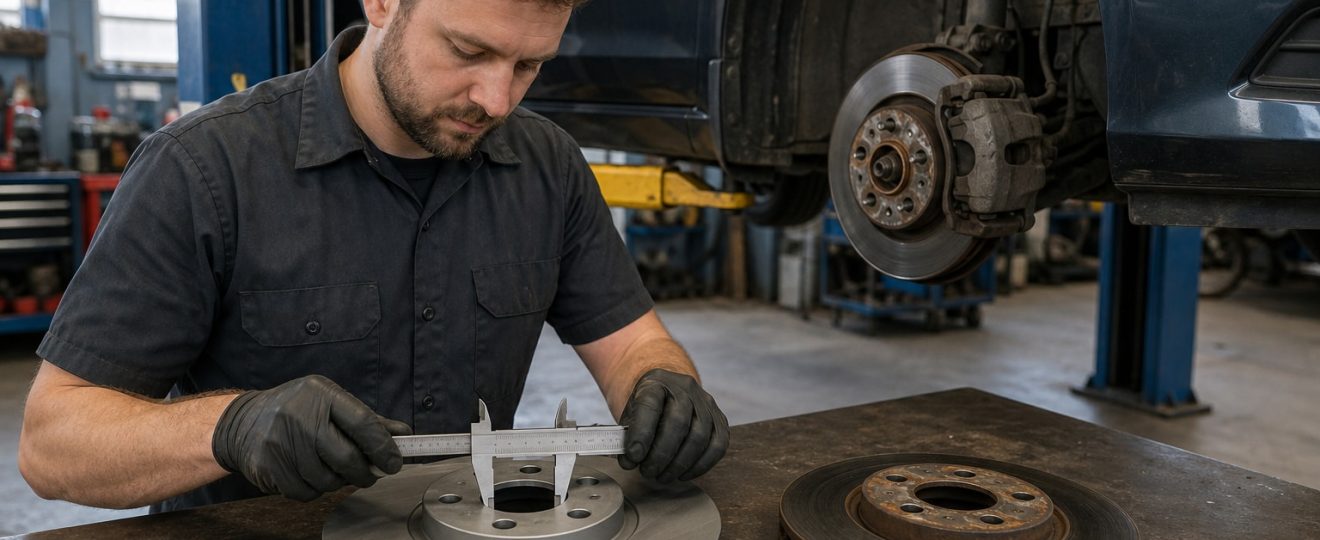
Compare the removed component with the candidate part on a clean bench. Measure the mounting-hole spacing, flange diameter, shaft length, hose or thread size, rotor diameter and thickness where relevant, and the position of locating tabs. For electrical parts, count connector pins and compare keying, latch position, wire orientation, sensor type, and any calibration or programming note.
Photographs should use the same angle and include a ruler or caliper where a dimension decides the match. A mirrored bracket, a connector rotated 90 degrees, or a hose port on the opposite face is easier to catch in a side-by-side image than in a product title. Also compare included hardware. Reusing a one-time-use fastener, seal, crush washer, clip, or stretch bolt can invalidate an otherwise correct installation.
Do not use appearance as the final test
Two parts can share an outer shell but have different spring rates, friction material, internal valves, temperature ranges, software, or load ratings. Conversely, a revised service part can look different and still be the approved replacement. When function depends on calibration or specification, the service information and orderable part number outweigh visual similarity.
FLAG EMISSIONS-SENSITIVE MODIFICATIONS
Extra caution is required when a part affects exhaust flow, fuel delivery, engine controls, sensors, or emissions hardware. The official EPA enforcement alert on defeat devices and tampering states that installing defeat devices or tampering with motor-vehicle emissions controls can lead to enforcement and penalties. A “fits” claim therefore does not establish that a modification is lawful for street use.
Check the label, application notes, required approvals, and local inspection rules before ordering. Avoid any listing that promises to disable a monitor, hide a fault, remove required hardware, or defeat an emissions function. For an ordinary repair, match the original system type and confirm whether programming, relearning, or an OEM procedure is required after installation.
PROTECT THE WARRANTY AND THE PAPER TRAIL
Aftermarket does not automatically mean “no warranty.” The FTC’s consumer guidance on auto warranties explains that using aftermarket or recycled parts does not by itself cancel warranty coverage, while damage caused by a defective part or incorrect installation can affect coverage for that damage. The same guidance recommends keeping maintenance and repair records.
Save the catalog page, fitment notes, invoice, packaging label, serial or lot number, and correspondence that confirmed the application. Ask for important fitment assurances in writing. Before opening a sealed electronic unit or installing a marked component, read the return conditions; an uninstalled mismatch is much easier to resolve than a scratched, programmed, fluid-filled, or electrically connected part.
RUN A PRE-INSTALLATION ACCEPTANCE CHECK
- Read the box: match the box label and the part label to the ordered number and revision.
- Inspect condition: look for shipping damage, corrosion, contamination, bent pins, missing caps, or opened seals.
- Compare side by side: check dimensions, mounting faces, connectors, ports, handedness, and included hardware.
- Confirm the procedure: obtain the correct torque values, fluid specification, bleeding sequence, alignment requirement, or software step from reliable service information.
- Dry-position only when safe: verify access and orientation without forcing threads, loading a bearing, contaminating a seal, or powering an incompatible unit.
- Stop on any discrepancy: document it and ask the seller or parts specialist to resolve it before installation.
Never invent a torque value from fastener size alone, and do not transfer the old part’s wear marks into a new setup as an alignment method. Safety-critical work may require calibrated tools, lifting equipment, diagnostic software, or a qualified technician. The goal of pre-installation verification is to catch a mismatch early, not to replace the repair procedure.
THE FOUR-POINT ORDER DECISION
A replacement part is ready to order only when four questions have a documented answer: Is this the exact vehicle configuration? Is this the current service part or a verified supersession? Do the physical and electrical interfaces agree? Are the safety, emissions, warranty, programming, and return conditions acceptable? If one answer is uncertain, pause and resolve it while the original part, labels, and vehicle data are still available.
This method takes a few minutes longer than clicking the first year-make-model result, but it creates a repeatable record and sharply reduces avoidable returns. More importantly, it separates a plausible listing from a part that can be installed according to the vehicle’s actual configuration and service requirements.

